


Tringa nebularia
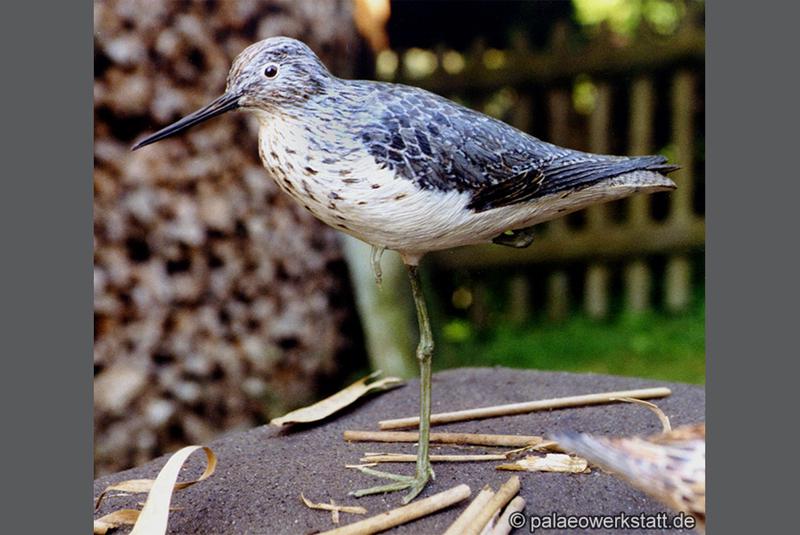
Description of the model:
The model shows the Greenshank in breeding feathers in a resting posture, lifting the left leg up.
The body-length of the completed model is about 40 cm.
Susanne Henssen made the model in co-operation with Philipp Bauer (zoological preparator, Adetswil, Switzerland).
The model was cast using high quality epoxy resin, reinforced with glassfibres. It was coloured using non-fade paint and varnish. We use glass-eyes.
Dimensions
bodylength ca. 32 cm.
Price
750,00 €
Our prices are quoted net and do not include packaging and freight.
Please respect our Conditions of delivery and payment.
Inquire about this model:
Model views Tringa nebularia
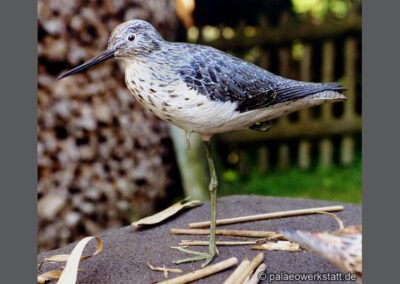
Tringa nebularia - Greenshank
Life-size model.
L.H. side view on a pedestal
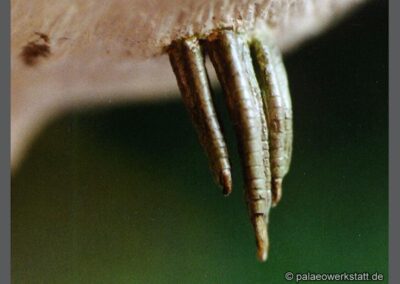
Tringa nebularia - Greenshank
Life-size model. Close-up of the foot
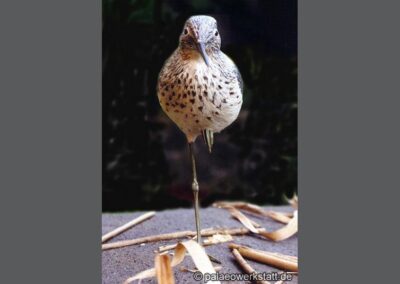
Tringa nebularia - Greenshank
Life-size model. frontview
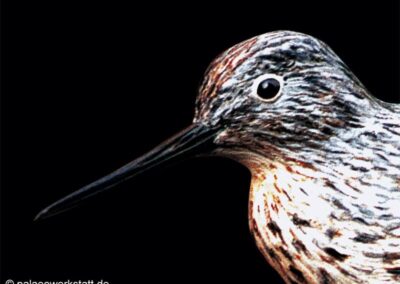
Tringa nebularia - Greenshank
Life-size model. Close-up of the head
Profile Tringa nebularia
Habitat
The greenshank is a wading bird (limicole) that migrates from Scandinavia and western Siberia and can be found in large numbers along the coasts and regularly in small groups along rivers and inland waters. The breeding areas are usually in the barren tundra along coniferous forests, in marshes and in raised bogs. Habitats with open water areas and extensive shallow water banks, such as lagoons or sewage fields, are favoured. “Forest tundra, open taiga, raised bogs. Outside the breeding season on mudflats and silt, on shallow banks of all kinds.” 2)
Sources
Today, greenshanks are only widespread in northern Europe, especially in Scandinavia, as well as in Russia. In the east, the range extends as far as Siberia. In Central Europe, the greenshank can only be observed as an occasional migrant. In southern Europe and Africa, greenshanks spend the winter in lagoons and marshes.
Further Informations
“Greenshanks are usually solitary birds and only form small flocks: they are most commonly found on freshwater shores and in shallow lagoons. On migration, they also appear in the smallest wetlands.” 2)
Reference for the text:
2) KEITH; ST. et.al. (1982): BLV Vogelführer. BLV Verlagsgesellschaft mbH, München; S. 497.