


Succinea putris
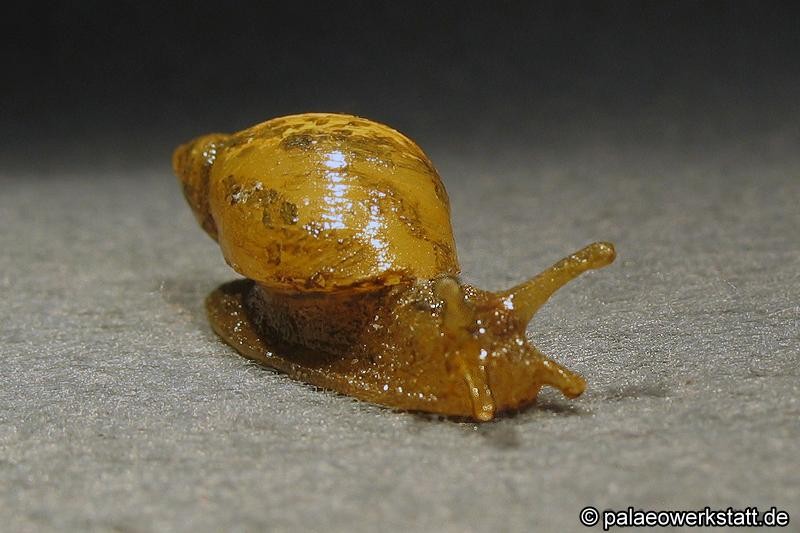
Description of the model:
We offer two models. One with (No.2) and one without pest infestation (No.1). The models are made of high quality epoxy resin and coloured using non-fade paint and varnish. Modelmaker: Susanne Henssen
Dimensions
Shell: 22 mm
body: 18 mm
Price
each 82 €
Our prices are quoted net and do not include packaging and freight.
Please respect our Conditions of delivery and payment.
Inquire about this model:
Model views Succinea putris
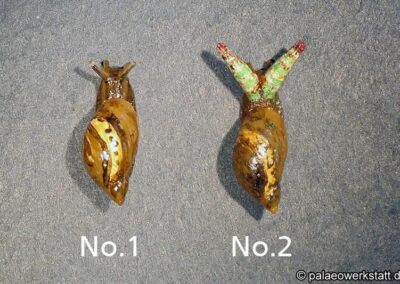
Succinea putris - Amber Snail
Please select the item No.1 and/or model No.2 (with pest infestation) for your order.
-400x284.jpg)
Succinea putris - Amber Snail
model No.2 with pest infestation, close-up
-400x284.jpg)
Succinea putris - Amber Snail
model No.2 with pest infestation, L.H. side view
-400x284.jpg)
Succinea putris - Amber Snail
model No.2 with pest infestation, R.H. side view
-400x284.jpg)
Succinea putris - Amber Snail
model No.1, L.H. side view"
-400x284.jpg)
Succinea putris - Amber Snail
model No.1, R.H. side view"
-400x284.jpg)
Succinea putris - Amber Snail
model No.1"
Profile Succinea putris
Habitat
On reeds and other vegetation at water body margins, on humid meadows and river valley woods
Sources
Europe, W Asia and N Asia, range gaps in the Mediterranean peninsulas
Further Informations
Especially conspicious are individuals, which tentacles are enormous extended, that seem to be have moving lateral stripes. This is caused by an infestation of the flatworm Leucochloridium paradoxum, which use the snail as an intermediate host. The terminal host are birds.
The bird distributes the parasite’s eggs by it’s excrements. The amber snail then infects itself by eating the eggs. The miracidia hatch inside the snail and infect it’s main digestive gland.
In the snail’s digestive gland the miracidia change into cercaries and produce sporocystes, long tubes that can contain several hundred cercaries.
One or several of these tubes stretch until into the snail’s tentacles and begin to pulsate in there. The obvious colour and the sporocystes’ movement attracts birds that hack for the snail’s tentacles. The bird rips off the snail’s tentacles which cannot be withdrawn because of the sporocystes tubes inside.
Inside the bird’s digestive tract the cercaries change into the parasite’s adult stage, which then reproduces sexually and lays eggs. Thos are distributed by the bird to infect further snails, which closes the generation cycle.
Reference for the text:
FALKNER, G. (1989): Der farbige Naturführer – Weichtiere. Lizenzausgabe mit Genehmigung der Mosaik Verlag GmbH, München für die Bertelsmann Club GmbH, Gütersloh. S. 166