


Mono Graptolith
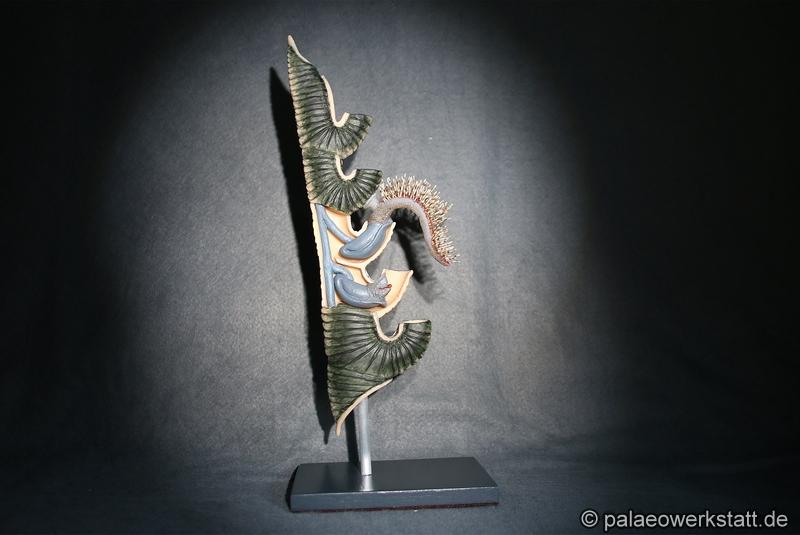
Description of the model:
Scale 5,5 : 1
The reconstruction shows a section of a mono-graptolith. Two living chambers provide an insight and show how the animals are located in the living chambers.
It is made of high-quality plastic and coloured with UV-resistant acrylic paints.
Dimensions
pedestal: 8 x 11 cm
model: 23,5 cm
mounted: 27 cm high
Price
1.860,00 €
Our prices are quoted net and do not include packaging and freight.
Please respect our Conditions of delivery and payment.
Inquire about this model:
Model views Mono Graptolith
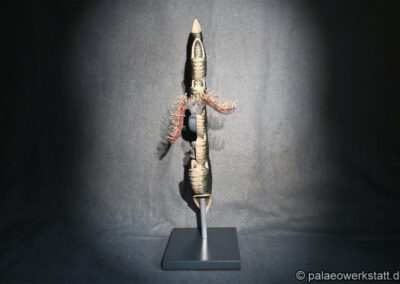
Reconstruction of the colony-forming, polyp-like animals, Front view Mono-Graptolith, model: scale 5.5 : 1
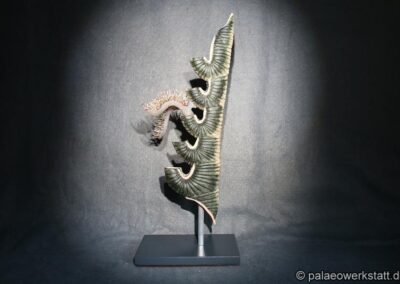
Reconstruction of the colony-forming, polyp-like animals, L.H.side view Mono-Graptolith, model: scale 5.5 : 1
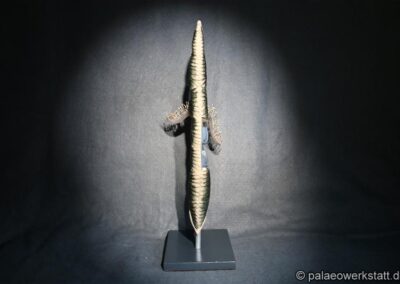
Reconstruction of the colony-forming, polyp-like animals, Rear view Mono-Graptolith, model: scale 5.5 : 1
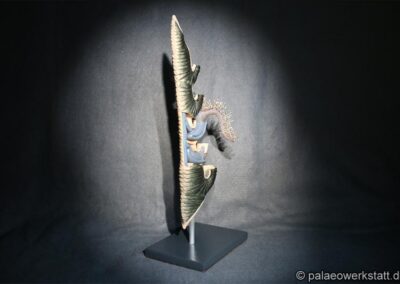
Reconstruction of the colony-forming, polyp-like animals. Mono-Graptolith, model: scale 5.5 : 1
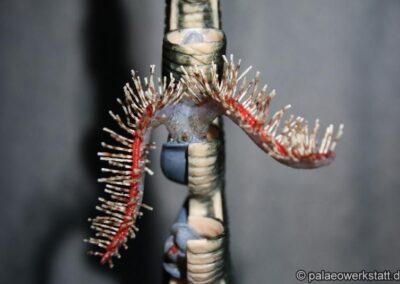
Detailed view of the polyps of the pterobranch Mono-graptolite model: scale 5.5 : 1
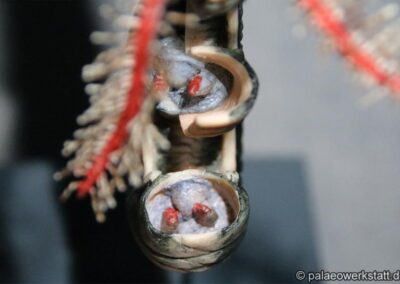
Close-up of the polyp-like animals retreating into the living chamber. Mono-graptolite model: scale 5.5 : 1
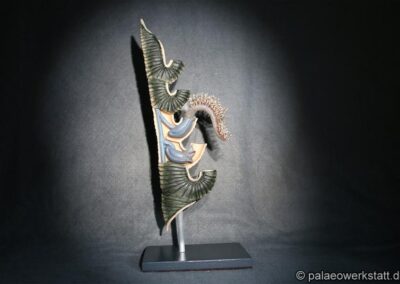
R.H.side view Mono-graptolite model: scale 5.5 : 1
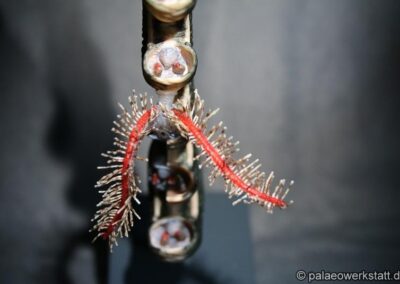
Detailed view of the polyps of the pterobranch, retracted at the top, unfolded at the bottom. Mono-graptolite model: scale 5.5 : 1
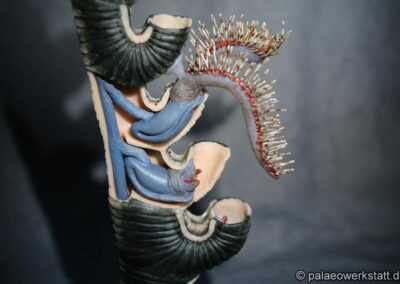
Detailed view of the polyp-like animals. Mono graptolite model: scale 5.5 : 1
Profile Mono Graptolith
Geological era
Devonian
Further Informations
Graptolites are the fossilised burrows (thecae) of colony-forming polyp-like animals. They are built from graptin, a unique structural protein, similar to chitin. The first species lived anchored in the sediment, but later there were also species that floated in the water like plankton. They are excellent index fossils from the Upper Cambrian to Lower Devonian because they are easy to recognise, underwent rapid evolutionary change and are distributed worldwide. They are mainly found in graptolite shales.
There are various growth forms within the graptolites, on the more or less curved axis of which one or more rows of living chambers (thecae) are arranged.
The model shows a section of a monograptid whose colony forms curved chambers on a straight axis.
Scientific categorisation was difficult for a long time. Based on the examination of histological sections of the fossil burrows, graptolites are classified in the Hemichordata (gill-hole animals). Following the discovery of the pterobranch Cephalodiscus graptolitoides in the deep sea near New Caledonia, some scientists now believe that graptolites should be categorised as pterobranchs (winged gills) because their living chambers are very similar to those of graptolites.