


Hyracotherium sp.
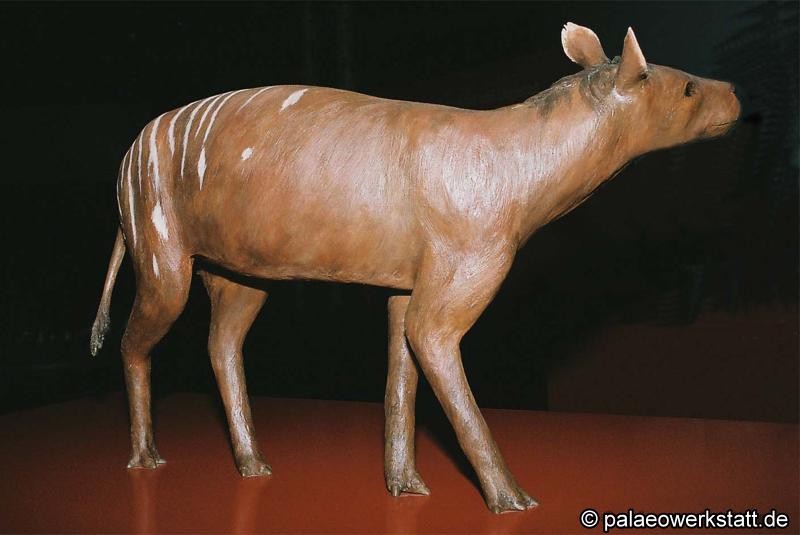
Description of the model:
Modelmaker: Susanne Henssen
The model was casted using high quality epoxy resin, reinforced with glassfibres. It was coloured using non-fade paint and varnish. We use glass-eyes.
Dimensions
bodylenth ca. 60 cm
Price
on demand
Inquire about this model:
Model views Hyracotherium sp.
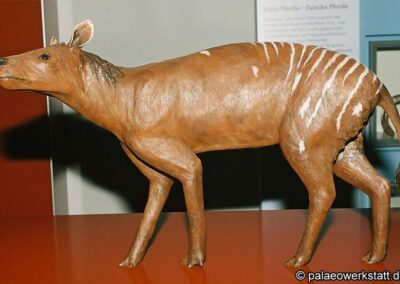
Life-size reconstruction Hyracotherium sp. - Eohippus
on display at the "Hippomaxx" Westfälisches Pferdemuseum, Münster (D).
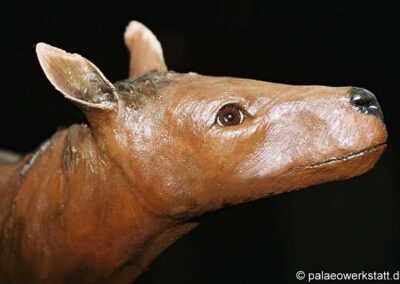
Life-size reconstruction Hyracotherium sp. - Eohippus
close-up of the head
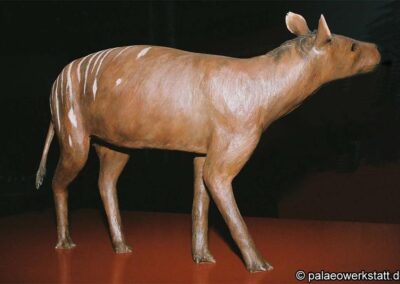
Hyracotherium sp. - Eohippus
R.H. side view of the life-size reconstruction
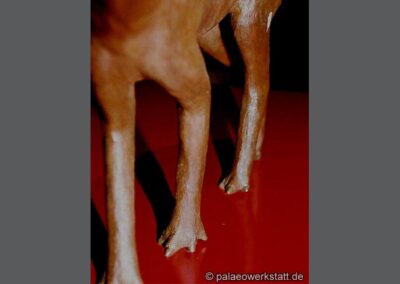
Life-size reconstruction Hyracotherium sp. - Eohippus
Important distinction are the four toes at the forefoot and three at the hindleg.
Profile Hyracotherium sp.
Habitat
The way of life of the small animal is different to that of present horses. The short crowned teeth show that Hyracotherium might have eaten more soft plant parts as for example leafs than grazing hard grass. Especially interesting are the feet. The forefoot has four digits and the hindfoot three digits. This feet were ideal for walking at soft grounds like those of rainforests. During the Eocene, large forests grew in the tropical climate. They offered enough food and cover to the small shy horse ancestor. There is no hint that Hyracotherium lived in herds.
Geological era
Tertiary (Lower Eocene)
Sources
Hyracotherium sp. (Eohippus – the dawn horse) was wide-spread over today’s Asia, Europe and North America in the Late Eocene, 55 Million years ago.
Further Informations
It is the earliest known ancestor of the horse and was not larger than a domestic cat. While the main line of descent of early horses became extinct in Europe and Asia in the late Oligocene, about 35 million years ago, the evolution of the horse went on in North America. The proportions of the skull, the short neck and arched back and especially the legs of Hyracotherium do not remember much at modern horses, but fossil evidence makes it possible to retrace the way of evolution.
The model is based on the original skeleton Eohippus venticolus Cope 1885, which is housed in the American Museum New York (No. 4832).