


Apateon pedestris
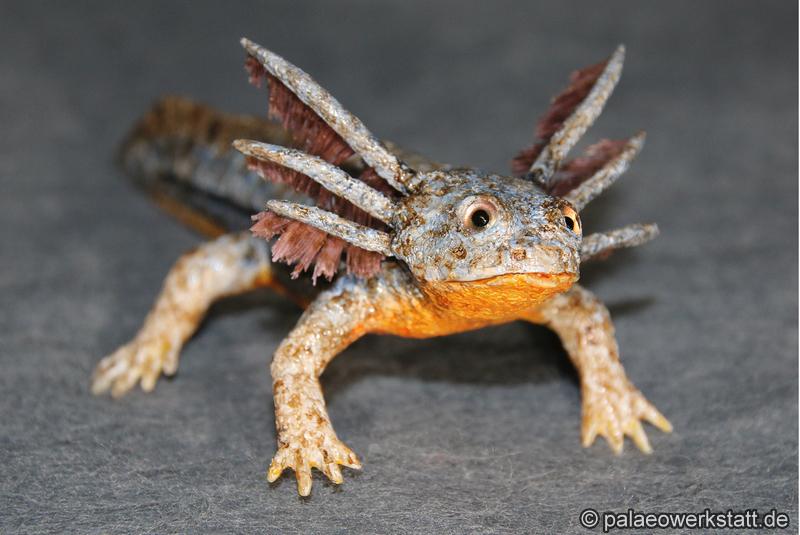
Description of the model:
Our model shows the actual state of the scientific results, next to the morphology with the described gills and caudal fin, the stripes at the skin are preserved 3) and the body was completely covered with rounded scales 2).
The model was cast using high quality epoxy resin was coloured using non-fade paint.
The eyes are made of glass.
modelmaker: Susanne Klein
Dimensions
body-length 12,5 cm
width: 5,5 cm
Price
714,00 €
Our prices are quoted net and do not include packaging and freight.
Please respect our Conditions of delivery and payment.
Inquire about this model:
Model views Apateon pedestris
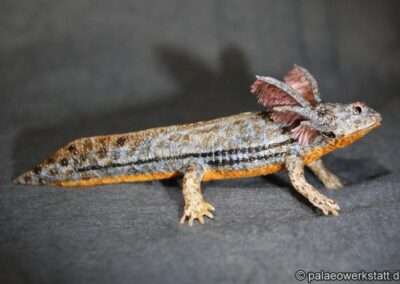
Apateon pedestris - branchiosaurid of the Lower Permian
R.H. side view of the life-size model
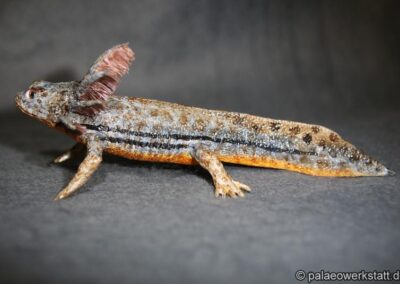
Apateon pedestris - branchiosaurid of the Lower Permian
L.H. side view of the life-size model
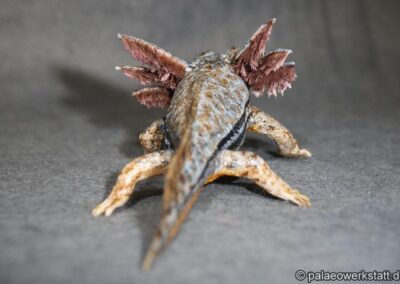
Apateon pedestris - branchiosaurid of the Lower Permian
rearview of the life-size model
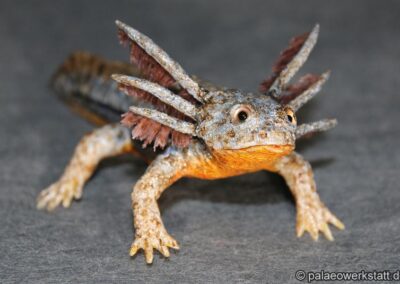
Apateon pedestris - branchiosaurid of the Lower Permian
life-size model
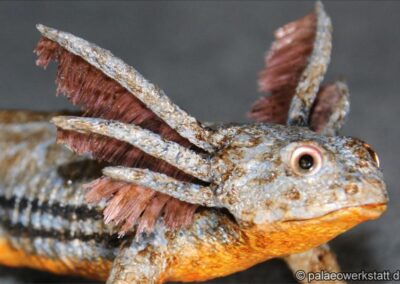
Apateon pedestris - branchiosaurid of the Lower Permian
Close-up of the life-size model. Please regard the gilles and the skin structure
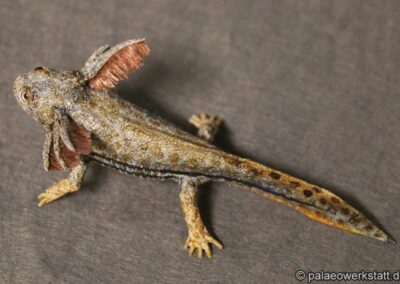
Apateon pedestris - branchiosaurid of the Lower Permian
Top view of the life-size model
Profile Apateon pedestris
Habitat
Presumably Apateon pedestris poised as today’s axolotl with comparable morphology on the ground of ponds and semi-permanent lakes, which didn’t contain much oxygen. That’s which he needed such large gills to breath. Its high dorsal fin was perfect to speed up in case of emergency.
Geological era
Lower Permian (Rotliegend)
Locality
Fossil sites are in Germany
– Rheinland-Pfalz (Münsterappel, Odernheim, Rehborn, Jeckenbach, Heimkirchen, Niederkirchen, St. Wendel),
– Thüringen (Friedrichroda, Tabarz, Winterstein),
– Sachsen (Niederhäslich, Clennen)
in Czechia (Olivětín) and France (Dracy St. Loup).
Storage location of the original
Fossil sites are in Germany (Rheinland-Pfalz (Münsterappel, Odernheim, Rehborn, Jeckenbach, Heimkirchen, Niederkirchen, St. Wendel), Thüringen (Friedrichroda, Tabarz, Winterstein), Sachsen (Niederhäslich, Clennen), in Czechia (Olivětín) and France (Dracy St. Loup).
Further Informations
Apateon pedestris lived in the Lower Permian (Rotliegend) about 295.0 to 290.1 million years ago.
Branchiosaurs can be decided in two ecomorphotypes: “stream-type and pond-type, which are well known from the living larval salamanders. The base for this distribution are two ecological features, changing content of oxygene and the differentiated enviroment structure of the water. The different morphological adaptions are the shape of the external gills and the caudal fin. The pond-type-forms show long external gills and an obtuse angeled high dorsal fin of the tail, which begins in the anterior half of the trunk. The ecomorphotype-species is Apateon pedestris from Odernheim in the Sahr-Nahe-basin.”1)
Reference for the text:
1) Werneburg, R. (2002): Apateon dracyiensis – eine frühe Pionierform der Branchiosaurier aus dem europäischen Rotliegend. Teil 2: Paläoökologie. – Veröffentlichungen des Naturhistorischen Museums Schleusingen 17: 17-32.
2) Boy, J.A. (1972): Die Branchiosaurier (Amphibia) des saarpfalzischen Rotliegenden (Perm, SW-Deutschland). Abhandlungen des hessischen Landesamtes für Bodenforschung 65: 1-137.
3) Werneburg, R. (2017): Earliest ‘nursey ground’ of temnospepondyl amphibians in the Permian-Semana (Naturwissenschaftliche Veröffentlichungen NHM Schleusingen),32: XX-XX, YY Figs., 4 Tab., Schleusingen.