


Eurypharynx pelecanoides

Description of the model:
The scientific model was done under supervision of Dr. Walter Etter (Natural History Museum Basel, Basel (CH).
The model was produced for the special exhibition “Deep sea” from 23rd March till 4th November 2012 in the Exhibitioncenter in Rosenheim LOKSCHUPPEN.
The model is made of reinforced epoxy resin and coloured using non-fade colours. We used glass eyes. The luminescent organ reflects under UV-light.
Assembly aids are fitted according to customer requirements.
Dimensions
85 cm long
Price
3.800,00 €
Our prices are quoted net and do not include packaging and freight.
Please respect our Conditions of delivery and payment.
Inquire about this model:
Model views Eurypharynx pelecanoides
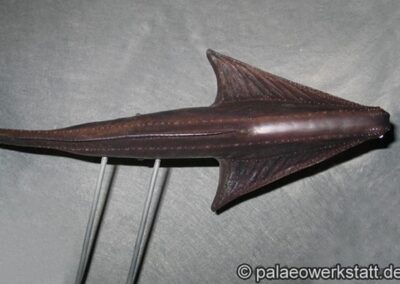
Eurypharynx pelecanoides -
Pelican eel
Close-up of the body in overhead view of the life-size model
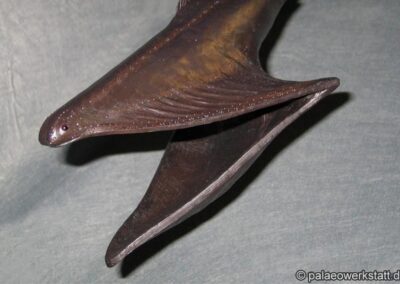
Eurypharynx pelecanoides -
Pelican eel
Close-up of the head, L.H. side view of the life-size model

Eurypharynx pelecanoides -
Pelican eel
Close-up of the tail of the life-size model. Nerve celles can be seen clearly and the luminescent organ reflects under UV-light in orange colour.
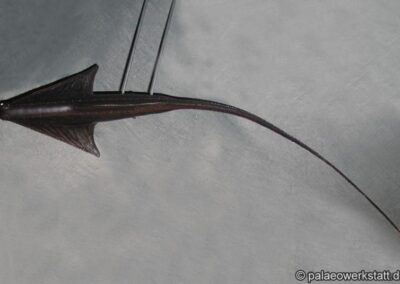
Eurypharynx pelecanoides -
Pelican eel
Overhead view of the life-size model
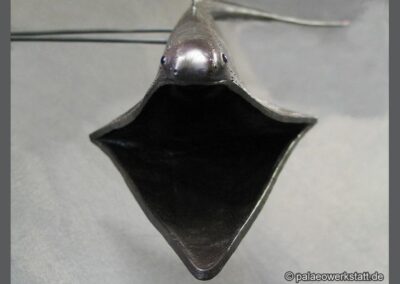
Eurypharynx pelecanoides -
Pelican eel
Front view of the life-size model
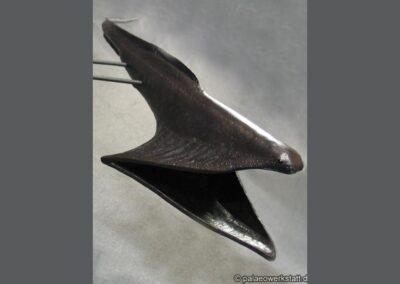
Eurypharynx pelecanoides -
Pelican eel
Close-up of the head of the life-size model
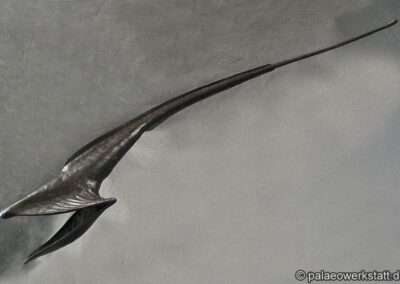
life-size model made of plastic, pelican eel, Eurypharynx pelecanoides
Eurypharynx pelecanoides -
Pelican eel
L.H. side view of the life-size model
Profile Eurypharynx pelecanoides
Habitat
deep sea 500m – 7000m depth
Further Informations
The pelican eel’s most notable feature is its enormous mouth, much larger than its body. The mouth is loosely-hinged, and can be opened wide enough to swallow a fish much larger than the eel itself. The pouch-like lower jaw resembles that of a pelican, hence its name. The stomach can stretch and expand to accommodate large meals, although analysis of stomach contents suggests that the eels primarily eat small crustaceans. Despite the great size of the jaws, which occupy about a quarter of the animal’s total length, it has only tiny teeth, which also would not be consistent with a regular diet of large fish.[1]
The eel uses a whip-like tail for movement. The end of the tail bears a complex organ with numerous tentacles, which glows pink and gives off occasional bright red flashes. This is presumably a lure to attract prey, although its presence at the far end of the body from the mouth suggests that the eel may have to adopt an unusual posture to use it effectively. Pelican eels are also unusual in that the lateral line organ projects from the body, rather than being contained in a narrow groove; this may increase its sensitivity.[1]
Reference for the text:
1. McCosker, John E. (1998). Paxton, J.R. & Eschmeyer, W.N.. ed. Encyclopedia of Fishes. San Diego: Academic Press. p. 90. ISBN 0-12-547665-5.
Referencing address:
Veranstaltungs + Kongress GmbH
Ausstellungszentrum Lokschuppen
Frau Elisabeth Scheueregger
D – 83022 Rosenheim