


Parabathynella badenwuerttembergensis
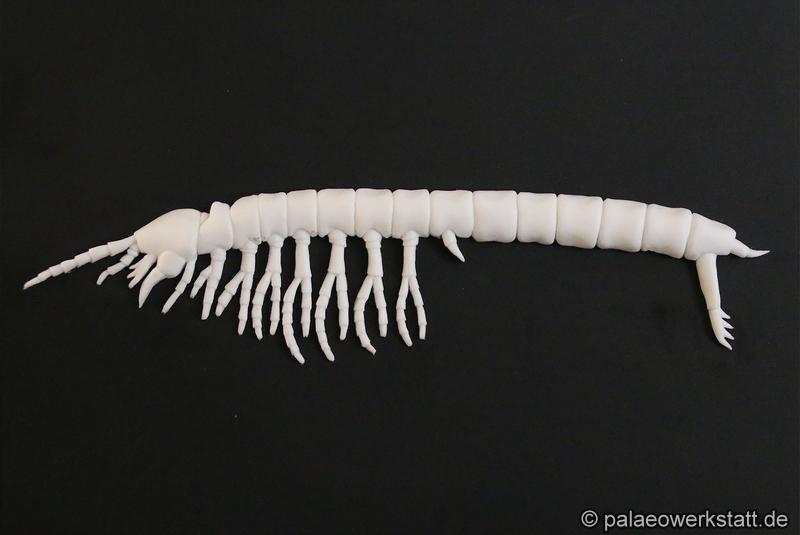
Description of the model:
The model is made of white and black highquality resin. It can be mounted on a black board with tactile letters and braille.
Modelmaker: Susanne Klein
Dimensions
Scale 1000:1
We offer two options of each model
Tactile model of the animal
Option 1: model of the animal on a black plastic board: size 27 x 27 cm
Option 2: model on a round presented black plastic board 27.9 cm in diametre
Tactile model of the leg
Option 1: model of the leg on a black plastic board: size 27 x 18 cm
Option 2: model on a round presented black plastic board 27.9 cm in diametre. On demand on a black aluminium board with white tactile hand lens, 45 cm in diametre.
Price
Option 1 Parabathynella badenwuerttembergensis, on rectangular board: 880,00 €
Option 2 Parabathynella badenwuerttembergensis on a circular board: 1.080,00 €
Option 3 leg of Parabathynella badenwuerttembergensis, on rectangular board: 880,00 €
Option 4 leg of Parabathynella badenwuerttembergensis on a circular board: 1.080,00 €
Our prices are quoted net and do not include packaging and freight.
Please respect our Conditions of delivery and payment.
Inquire about this model:
Model views Parabathynella badenwuerttembergensis
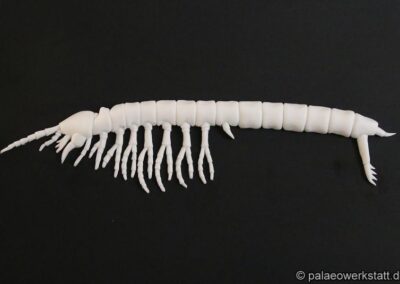
Parabathynella badenwuerttembergensis
Tactile model, scale 1000:1
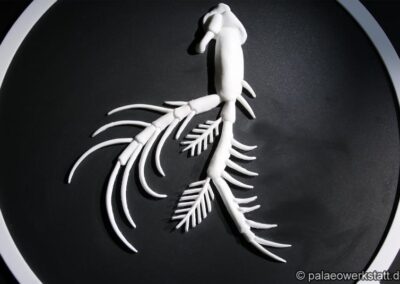
Parabathynella badenwuerttembergensis
Tactile model of one leg
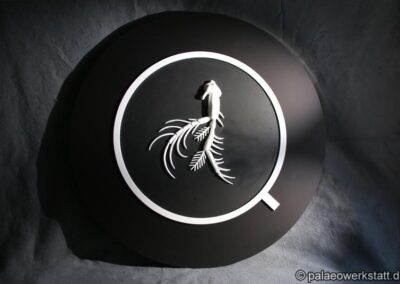
Parabathynella badenwuerttembergensis
Tactile model of the leg presented in a tactile hand lens.
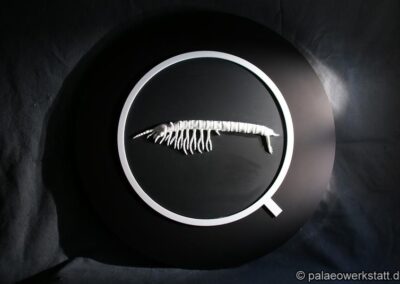
Parabathynella badenwuerttembergensis
Tactile model scale 1000:1 presented in a tactile hand lens
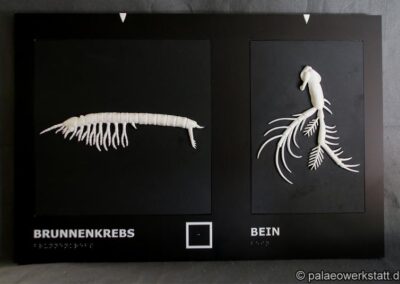
Parabathynella badenwuerttembergensis
Tactile models next to another with tactile letters and Braille. Left side, body scale 1000:1.
Right side: leg of the specimen
Profile Parabathynella badenwuerttembergensis
Habitat
Groundwater (stygophil)
Further Informations
The Syncarida are referred to as living fossils, as they are already known from the Carboniferous period, 300 million years ago. They are therefore a very ancient group of freshwater crustaceans. The main distribution centre of the Syncarida and their origin are thought to be in the southern hemisphere (former Gondwana continent).
In Europe, only the Bathynellacea group, the so-called well crabs, are found. The water crabs are distributed worldwide, in Germany only the families Bathynellidae and Parabathynellidae occur with several genera and a total of 9 species (Mösslacher & Hahn 2003). Interestingly, their recent representatives live exclusively in groundwater, with a few exceptions such as in the profundal of Lake Baikal (Noodt 1965). It is assumed that they migrated into the groundwater very early on. There they were able to survive unfavourable periods, while the surface forms of the Syncarida presumably died out. They move by swimming and crawling. The diet appears to be predominantly filter-feeding and ‘grazing’, but predatory feeding has also been observed.
Reference for the text:
We would like to thank the following for providing the specialised information
Dr Hans Jürgen Hahn, Dr Andreas Fuchs and Sven Berkhoff of the Institute for Groundwater Ecology IGÖ GmbH, Landau