


Diacyclops languidus
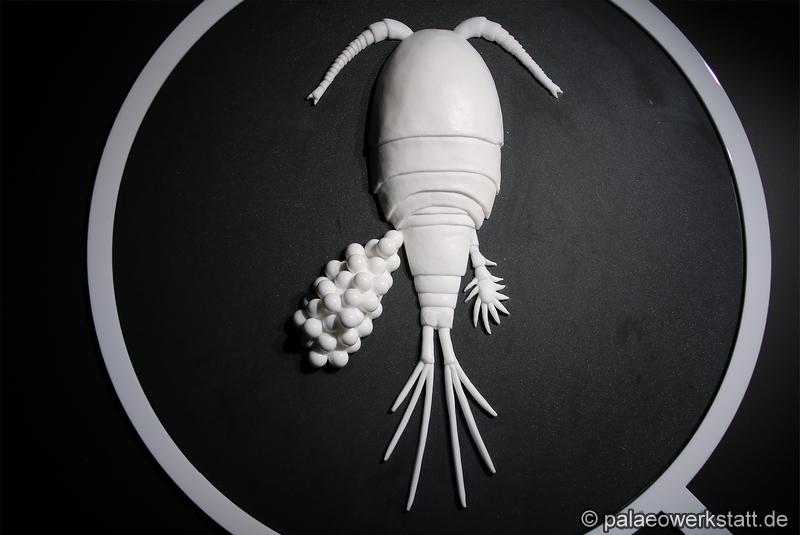
Description of the model:
scale 5000:1
The model shows the animal in dorsal view. At it left side one eggpouch is visible which females use to carry at both sides of the body. In case of the model we do not show the right eggpouch in order to show one paddle as additional information.
The model is made of white and black highquality resin. It can be mounted on a black ground with tactile letters and braille.
Modelmaker: Susanne Klein
Dimensions
23.5 x 27 cm on a black resin board
Size of the animal 25 cm long
The model shows the crustacean at a magnification of 5000 : 1
On request, we can mount the model in a matt black anodised circular aluminium plate with a white, tactile magnifying glass symbol. Diameter 45 cm mounted on a 12 mm thick multiplex plate.
Price
680,00 €
Our prices are quoted net and do not include packaging and freight.
Please respect our Conditions of delivery and payment.
Inquire about this model:
Model views Diacyclops languidus
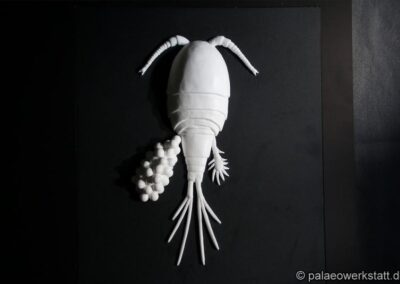
Diacyclops languidus. Tactile model magnification 5000:1. Left side with eggpouch. Right side without, but the paddle can be seen and touched.
Diacyclops languidus. Tactile model of the original size.
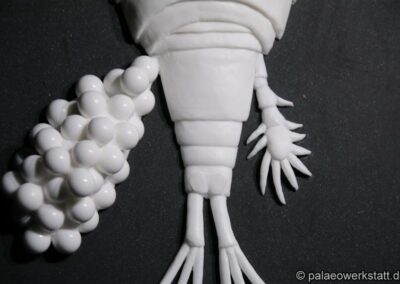
Diacyclops languidus. Tactile model magnification 5000:1. Left side with eggpouch. Right side without, but the paddle can be seen and touched.
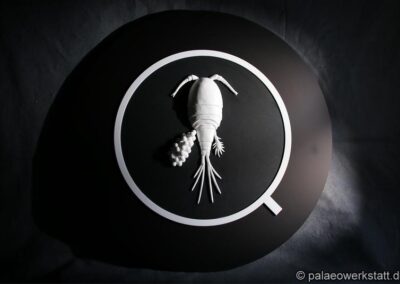
Diacyclops languidus. Tactile model magnification 5000:1 shown in a tactile magnifying glass.
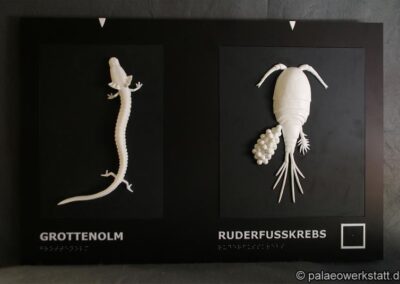
life-size tactile models on a black ground with tactile letters and braille of Proteus anguinus, Cave Salamander (left side) and
Diacyclops anguidus (right side)
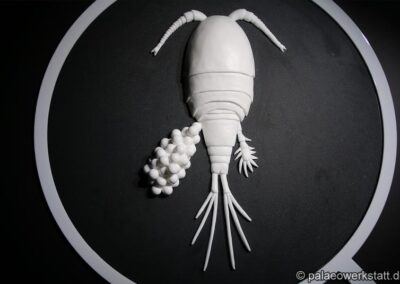
Diacyclops languidus. Tactile model magnification 5000:1 shown in a tactile magnifying glass.
Profile Diacyclops languidus
Sources
in small freshwater and groundwater all over middle of europe.
Further Informations
Cyclopoida (hoppers)
With 670 species described worldwide, the cyclopids are very diverse. Many of these species (approx. 150) are obligate or facultative colonisers of groundwater systems. The stygobiont species are usually < 1 mm in size. They live in the substrate of karst and pore groundwater. There they mainly feed on detritus and other organic material, but some species are also predators. Some of the species are stygophilic and actively migrate into the groundwater. The diversity of cyclopids has so far been greatly underestimated, as many species have turned out to be species complexes that can hardly be distinguished morphologically, but can be differentiated genetically (Mösslacher & Hanhn 2003).
D. languidus is the only Diacyclops species which have antennas that consists of 16 joints. Its colour is uniformly whitish grey.
Female: Length 0.7–1.0 mm
Male: Length 0.5–0.8 mm