


Sperifer sp.
Description of the model:
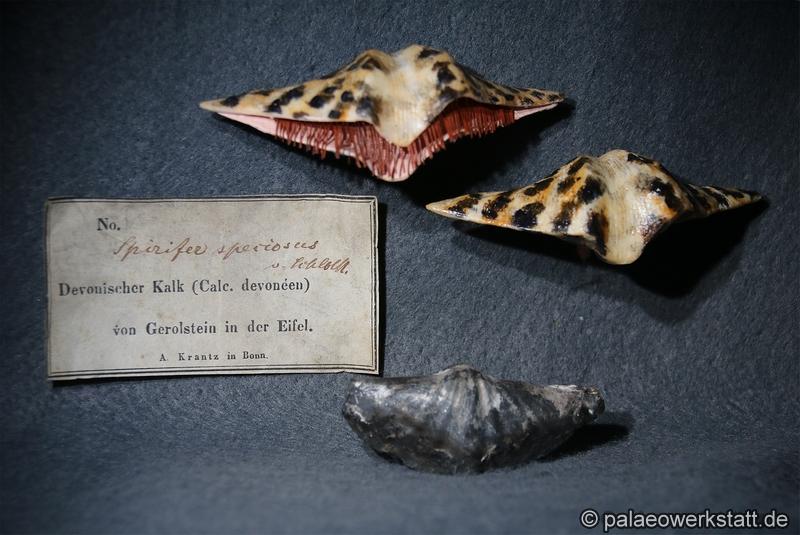
The models are made by using casted fossil original finds, found in Gerolstein (D), middle devonian side. We offer two models.
No.1: Spirifer sp. with open shells. Visible are the lophophor and the tentacles used by the animal to filter the water for food particles.
No.2: Spirifer sp. with closed shells
Dimensions
No.1: Spirifer sp. with open shells. Visible are the lophophor and the tentacles used by the animal to filter the water for food particles.
Width: 7.4 cm
Depth: 2.8 cm
Height: 2.3 cm with pedicle 3.1 cm
No.2: Spirifer sp. with closed shells
Width: 7.4 cm
Depth: 2.8 cm
Height: 2 cm with pedicle 3.1 cm
Price
No.1: open shells 295,00 €
No.2: closed shells 125,00 €
Our prices are quoted net and do not include packaging and freight.
Please respect our Conditions of delivery and payment.
Inquire about this model:
Model views Sperifer sp.
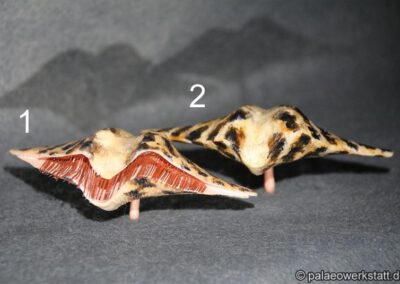
Spirifer sp. - reefbuilding devonian brachiopod.
We offer two models.
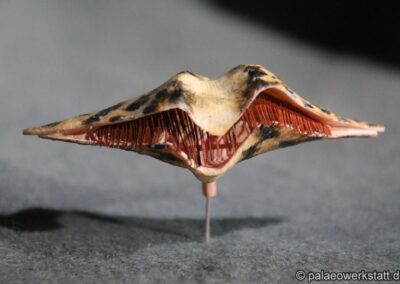
Spirifer sp. - reefbuilding devonian brachiopod Model No.1
front view, visible is the lophophore with its fine haires which filter food particles out of the water.
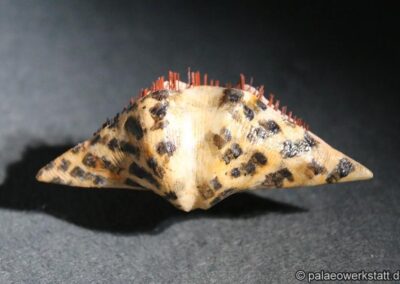
Spirifer sp. - reefbuilding devonian brachiopod.
Model No. 1 with open shells.
Top view at the brachial valve
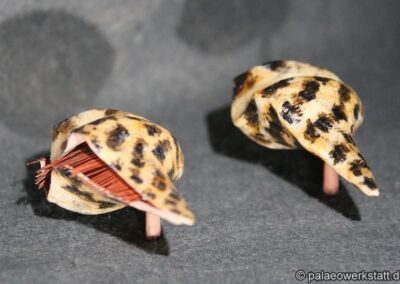
Spirifer sp. - reefbuilding devonian brachiopod.
lateral view two models.
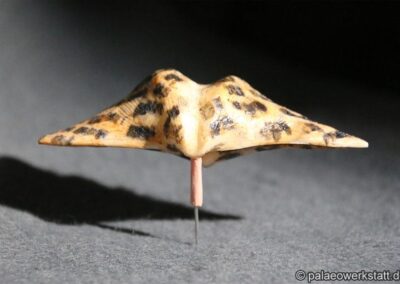
Spirifer sp. - reefbuilding devonian brachiopod Model No.1
rear view
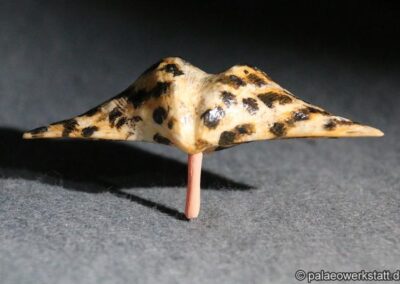
Spirifer sp. - reefbuilding devonian brachiopod.
Model No.2 with closed shells.
rear view
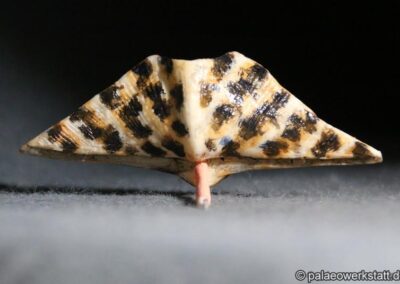
Spirifer sp. - reefbuilding devonian brachiopod.
Model No.2 with closed shells.
bottom view at the brachial valve
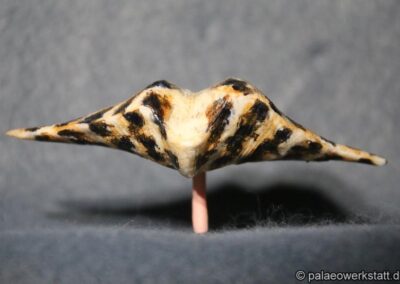
Spirifer sp. - reefbuilding devonian brachiopod.
Model No.2 with closed shells.
front view
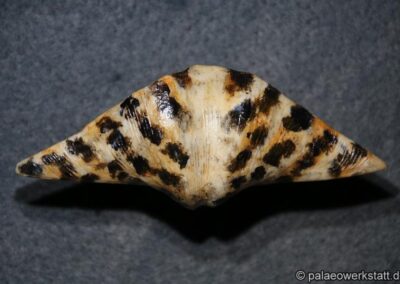
Spirifer sp. - reefbuilding devonian brachiopod.
Model No. 2 with closed shells.
Top view at the pedical valve
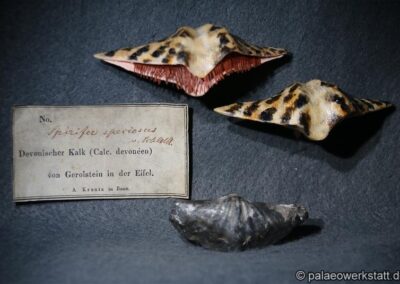
Spirifer sp. - reefbuilding devonian brachiopod next to its fossil
Profile Sperifer sp.
Geological era
Silurian – Jurassic
Further Informations
At their peak in the Paleozoic era, the brachiopods were among the most abundant filter-feeders and reef-builders in the sea, and occupied as well ecologigal niches. Brachiopod fossils have been useful indicators of climate changes during the Paleozoic.
Spirifer sp. attach to hard surfaces with its pedicle (“stalk”). It has a lophophore, a crown of tentacles whose cilia (fine hairs) create a water current that enables them to filter food particles out of the water.
Referencing address:
C. Kurz: Naturmuseum im Ottoneum Kassel