


Melanerpeton tenerum
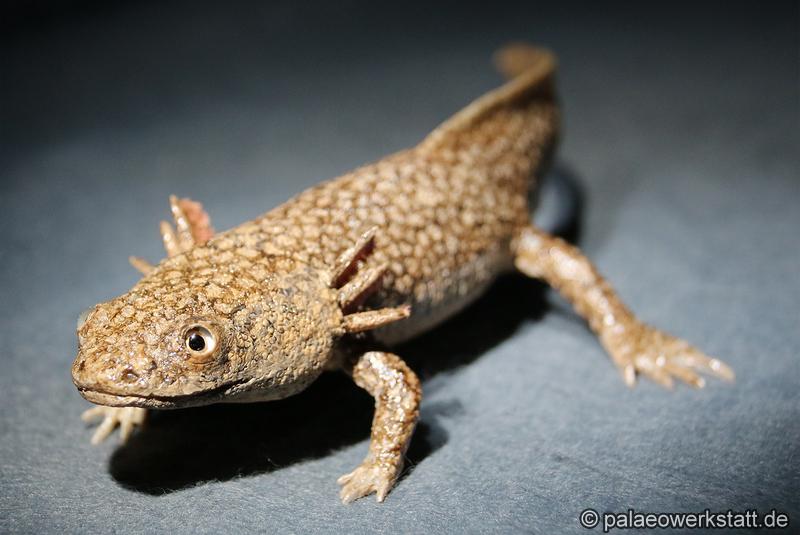
Description of the model:
Our model shows the actual state of the scientific results, next to the morphology with the described gills and caudal fin, the skin pattern and rounded scales, which covered the whole body are preserved 2).
The model was cast using high quality epoxy resin was coloured using non-fade paint.
The eyes are made of glass.
modelmaker: Susanne Klein
Dimensions
body length: 20,5 cm
space requirement: 19 x 8,2 cm
Price
798,00 €
Our prices are quoted net and do not include packaging and freight.
Please respect our Conditions of delivery and payment.
Inquire about this model:
Model views Melanerpeton tenerum
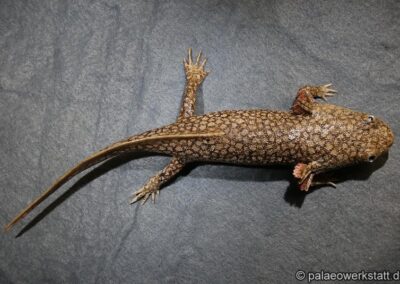
Melanerpeton tenerum - Branchiosaurid of the Lower Permian,
overhead view of the life-size model
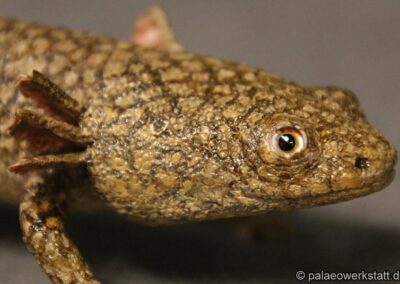
Melanerpeton tenerum - Branchiosaurid of the Lower Permian,
Close-up of the head, life-size model
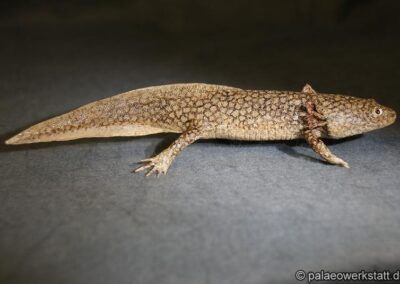
Melanerpeton tenerum - Branchiosaurid of the Lower Permian,
R.H. side view of the life-size model
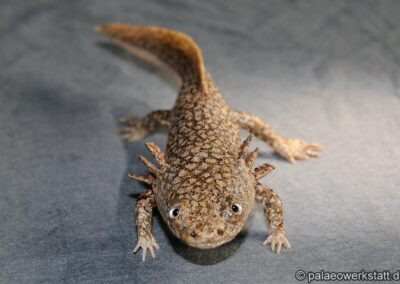
Melanerpeton tenerum - Branchiosaurid of the Lower Permian,
front view of the life-size model
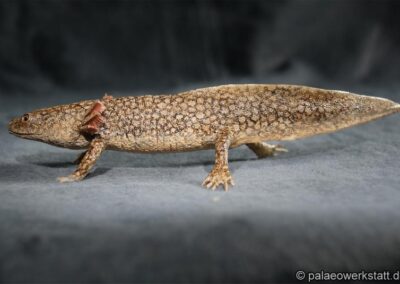
Melanerpeton tenerum - Branchiosaurid of the Lower Permian,
L.H. side view of the life-size model
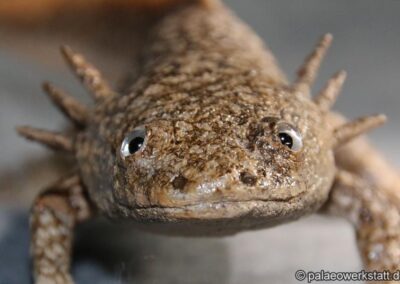
Melanerpeton tenerum - Branchiosaurid of the Lower Permian,
Close-up of the head,
life-size model
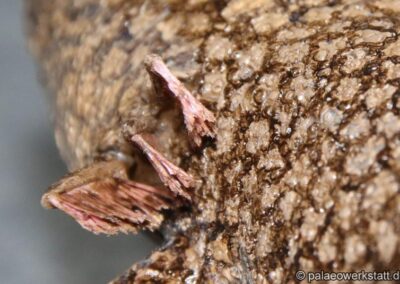
Melanerpeton tenerum - Branchiosaurid of the Lower Permian,
Close-up of the short external gills,
life-size model
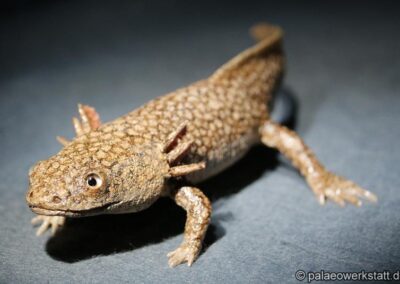
Melanerpeton tenerum - Branchiosaurid of the Lower Permian, Life-size model
Profile Melanerpeton tenerum
Habitat
Fossil finds show short external gills. “The short external gills indicate water with a high content of oxygene, which was probably fresher and cleaner. Ponds, pools, small lakes or part of lakes with a high content of oxygen intercalated in river courses or situated on their flood plains are the possible environment.” 2)
Geological era
Lower Permian (Cisuralian (Asselian))
Further Informations
Melanerpeton tenerum lived in the Lower Permian about 298,9 bis 295,5 million years ago in the area of today’s Europe. Melanerpeton tenerum is a branchiosaurid.
Branchiosaurs can be decided in two ecomorphotypes: “stream-type and pond-type, which are well known from the living larval salamanders. “The population of Melanerpeton tenerum from the Börtewitz Lake belongs to the “stream-type”…Relatively short external gills and a low dorsal fin of the tail, which begins in the posterior half of the trunk, are characteristically. … 2)
Reference for the text:
1) Werneburg, R. (2002): Apateon dracyiensis – eine frühe Pionierform der Branchiosaurier aus dem europäischen Rotliegend. Teil 2: Paläoökologie. – Veröffentlichungen des Naturhistorischen Museums Schleusingen 17: 17-32.
2) Werneburg, R. (2007) Timeless design: colored pattern of skin in early Permian branchiosaurids (Temnospondyli: Dissorophoidea). Journal of Vertebrate Paleontology 27, 1047-1050.