


Neomys fodiens

Description of the model:
The model is produced using high quality epoxy resin, it is coloured using non-fade paint and varnish.
As a result they are protected from damage typical caused by insects and changing climate.
Modelmaker is Susanne Henssen.
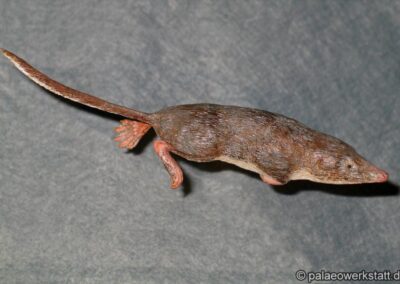
The model shows a swimming position, where the hair between the toes of the left hind foot is goed visible.
Dimensions
14 cm tail to head
Price
360,00 €
Our prices are quoted net and do not include packaging and freight.
Please respect our Conditions of delivery and payment.
Inquire about this model:
Model views Neomys fodiens
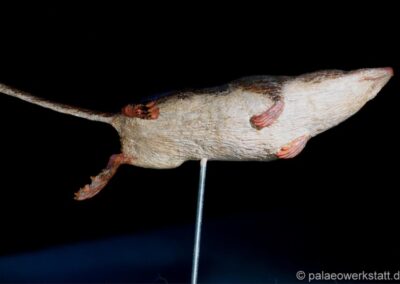
Neomys fodiens - water shrew
view from below of the life-size model
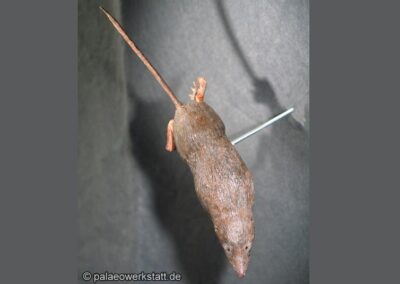
Neomys fodiens - water shrew
overhead view of the life-size model
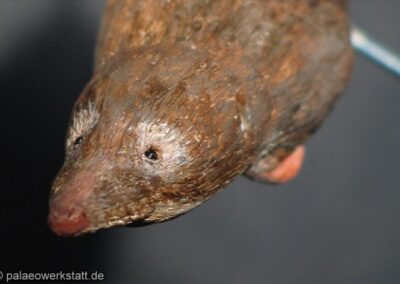
Neomys fodiens - water shrew
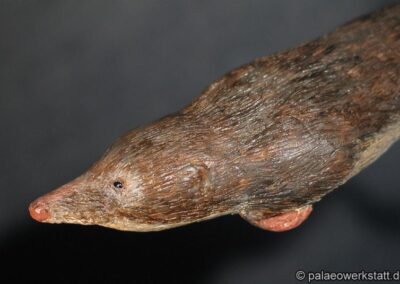
close-up of the head of the life-size model
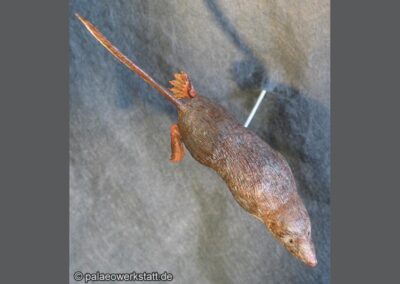
Neomys fodiens - water shrew
overhead view of the life-size model
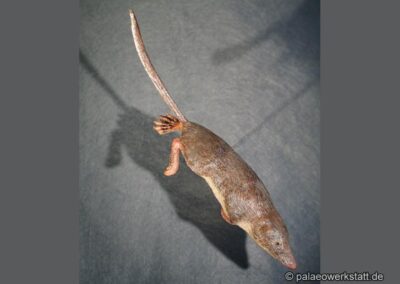
Neomys fodiens - water shrew
R.H. side view of the diving life-size model
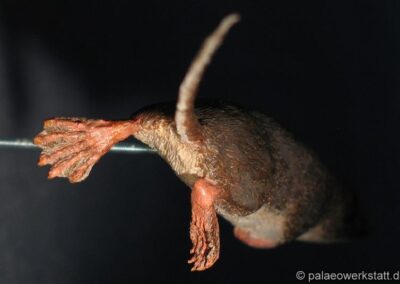
Life-size model Neomys fodiens - water shrew
rear view. Please pay attention to the details of the feet.
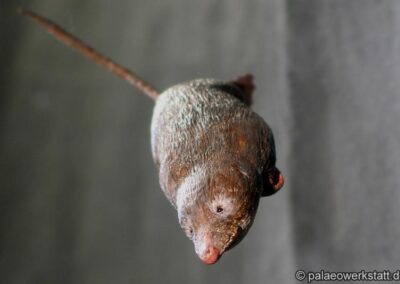
Neomys fodiens - water shrew
front view of the life-size model
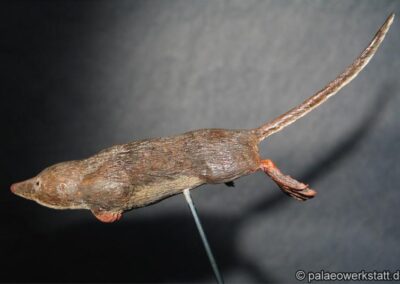
Neomys fodiens - water shrew
L.H. side view of the life-size model
Neomys fodiens - water shrew
the head in detail l.h.side view of the life-size model
Neomys fodiens - water shrew
R.H. side view of the life-size model
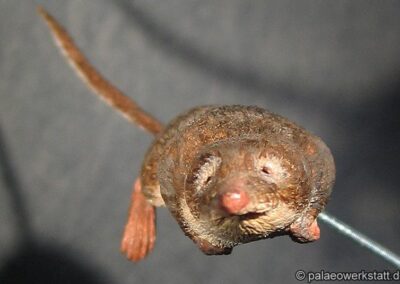
Neomys fodiens - water shrew front view of the life-size model
Profile Neomys fodiens
Habitat
It occurs in a wide variety of wetland habitats, both freshwater and coastal, including lakes, rivers, streams, marshes, bogs, damp grasslands, humid woodlands, sea shores and intertidal wetlands. It is the most aquatic of all European shrews. It hunts on land and in water for invertebrates, including crustaceans, and occasionally takes small fish and amphibia (Sokolov and Orlov 1980, Spitzenberger 1999, Smith and Xie in press). It paralyses large prey with its venomous saliva (Stone 1995, Smith and Xie in press). It is highly territorial, with males only moving out of territory during the breeding season. The water shrew is one of the few poisoness mammals in Europe.
Sources
The water shrew has a large range extending from the British Islands eastwards to Lake Baikal, Yenisei River (Russia), Tien Shan (China), and northwest Mongolia. In the Mediterranean is ranges from northern Spain eastwards to Bulgaria.In Europe it is generally widespread throughout, with the exception of southern Iberia. It occurs only sporadically on the Balkan peninsula, where it is largely restricted to the mountains. It occurs from sea level to over 2.500 m (Stone 1995). The distribution of the species recently expanded southwards in Italy owing to a new record in the Sila massif (Aloise et al. 2005).
Further Informations
This species is semi-aquatic with water repelling fur, which is efficiently insulating them against cold and wet.
Their ears are only visible as tufts of white hairs and can be closed when under water (Macdonald and Barrett, 1993). Their saliva is slightly venomous and is used to stun larger prey. Very interesting are their hindfeet, which have have a fringe of stiff, silvery hairs which help them to swim, and the tail has a hairy keel on the ventral surface (Carter & Churchfield, 2006).
The water shrew is protected.
Because the models are artifical, the Conventions on International Trade in Endangered Species of Wild Fauna and Flora do not apply, there is no permit required.