


Sphagnum spec.
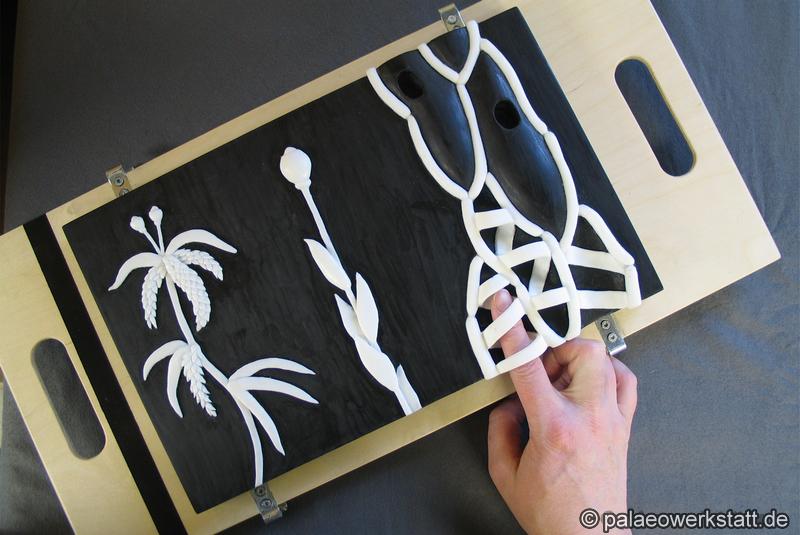
Description of the model:
The tactile model is made of glass fibre reinforced plastic. It is waterproof so that the centre hyalocyte can also be filled with water.
On request, we offer a wooden crate on which the model is firmly mounted for transport into the field.
Dimensions
Tactile model: 20 x 30 x 4 cm without transport box
The crate can be customised to your requirements. We will be happy to make you an offer.
Price
780,00 €
incl. wodden transport box on demand
Our prices are quoted net and do not include packaging and freight.
Please respect our Conditions of delivery and payment.
Inquire about this model:
Model views Sphagnum spec.
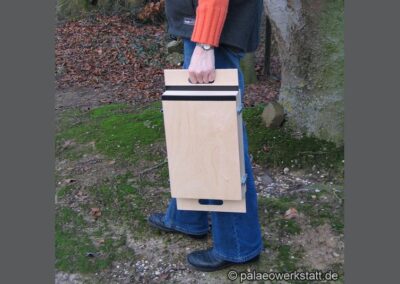
peat moss plant - transportable tactile model - perfect to use on a guided tour
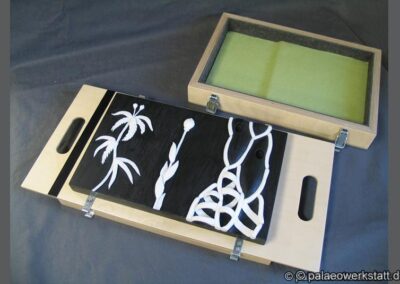
peat moss plant - transportable tactile model.
open box.
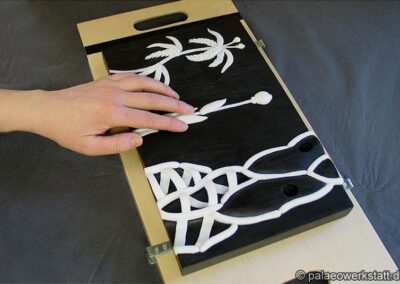
peat moss plant - transportable tactile model
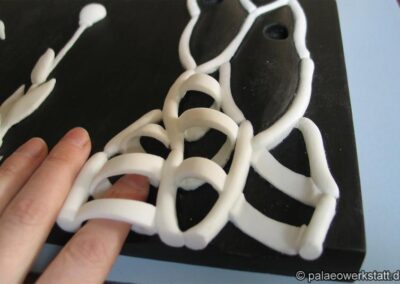
peat moss plant - transportable tactile model.
Close-up of the leaf cell structure
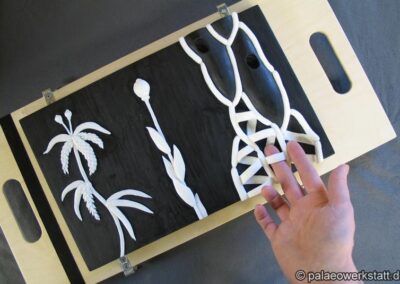
peat moss plant - transportable tactile model
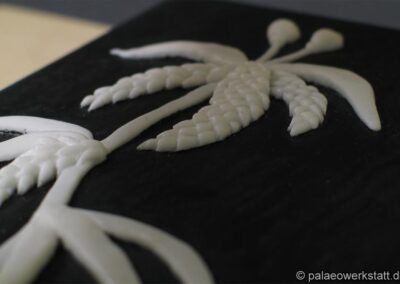
peat moss plant - transportable tactile model
Close-up of the plant
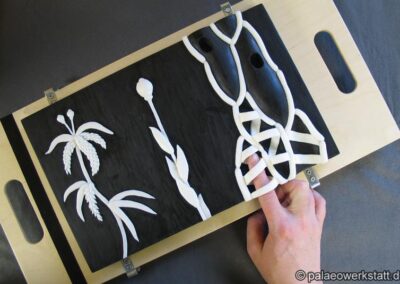
peat moss plant - transportable tactile model
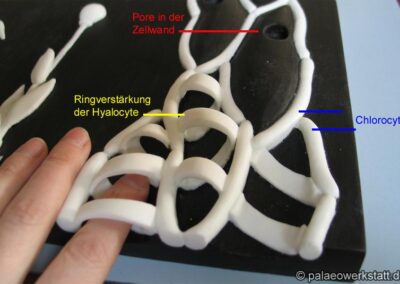
peat moss plant - transportable tactile model.
Close-up of the leaf cell structure
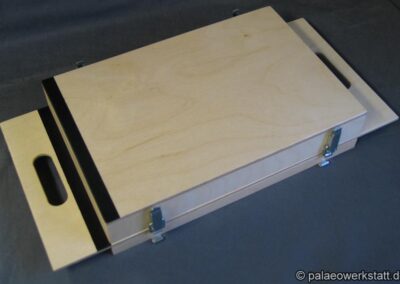
peat moss plant - transportable tactile model.
closed box
Profile Sphagnum spec.
Sources
Peat mosses can be found on all continents except Antarctica. In the tropics, they mainly colonise mountainous regions. The largest proportion of the distribution is in the northern hemisphere, with a clear focus on the large moorland areas of the cold to warm temperate climate zones of northern Europe, Asia and North America.
Further Informations
The model was developed for the Oberberg Biology Station as part of the ‘Nature and environmental education for all’ project with Anika Au (née Poetschke) and successfully tested by members of the Kleve District Association for the Visually Impaired.
The model offers the opportunity to grasp the structure of a peat moss plant with two hands during lessons or guided tours in the field. In our experience, it is necessary to guide the touching hand for a more precise understanding.
An overview of the structure of the plant is given on the left. The stem, branches and two terminal buds with spore capsules (sporangia) can be felt. Some of the branches are shown scaly in relief to emphasise that many individual leaves are attached to them, which are made up of individual cells. In order not to overstimulate with too much structure, not all branches are shown with leaves.
In the centre, a branch with leaflets and heads is modelled with the sporangia enlarged.
To the right, the structure of a leaf is enlarged in the section and can be felt in detail down to the cell. It illustrates the cell walls with the pore (hole), which is used to absorb water. The living cells (chlorocytes) can be felt laterally as filled cells, while the dead water storage cells (hyalocytes) can also be felt from the inside. This clearly shows the ring tension of the hyalocytes, which actively draw water through the pore in the cell wall. The model explains to sighted and visually impaired people, even in the field, why each peat moss plant can store so much water.
It is kept in contrasting black and white because this contrast can still be perceived by some visually impaired people.